
Prompt & Circumstance #2
Why Producing AI Music is Still Producing
May 5, 2025
Taste, Vision, and Iteration Still Define the Role—Even When the Tools Change
I’ve produced over 5,000 AI-generated songs across dozens of albums and musical personas. I’ve spent hours crafting lyrics, conceptualizing sonic identities, iterating through variations, and discarding anything that didn’t meet my personal standard. The tools I use are new—generative AI platforms like Suno, OpenAI, and ElevenLabs—but the process is strikingly familiar to anyone who’s ever spent time in a music studio. In fact, the core creative responsibility of a producer hasn’t changed at all. Technology has evolved. The role didn’t.
There’s a famous quote from Rick Rubin, often shared and admired by traditional artists. When asked what he brings to the table if he has no technical ability, Rubin replied:
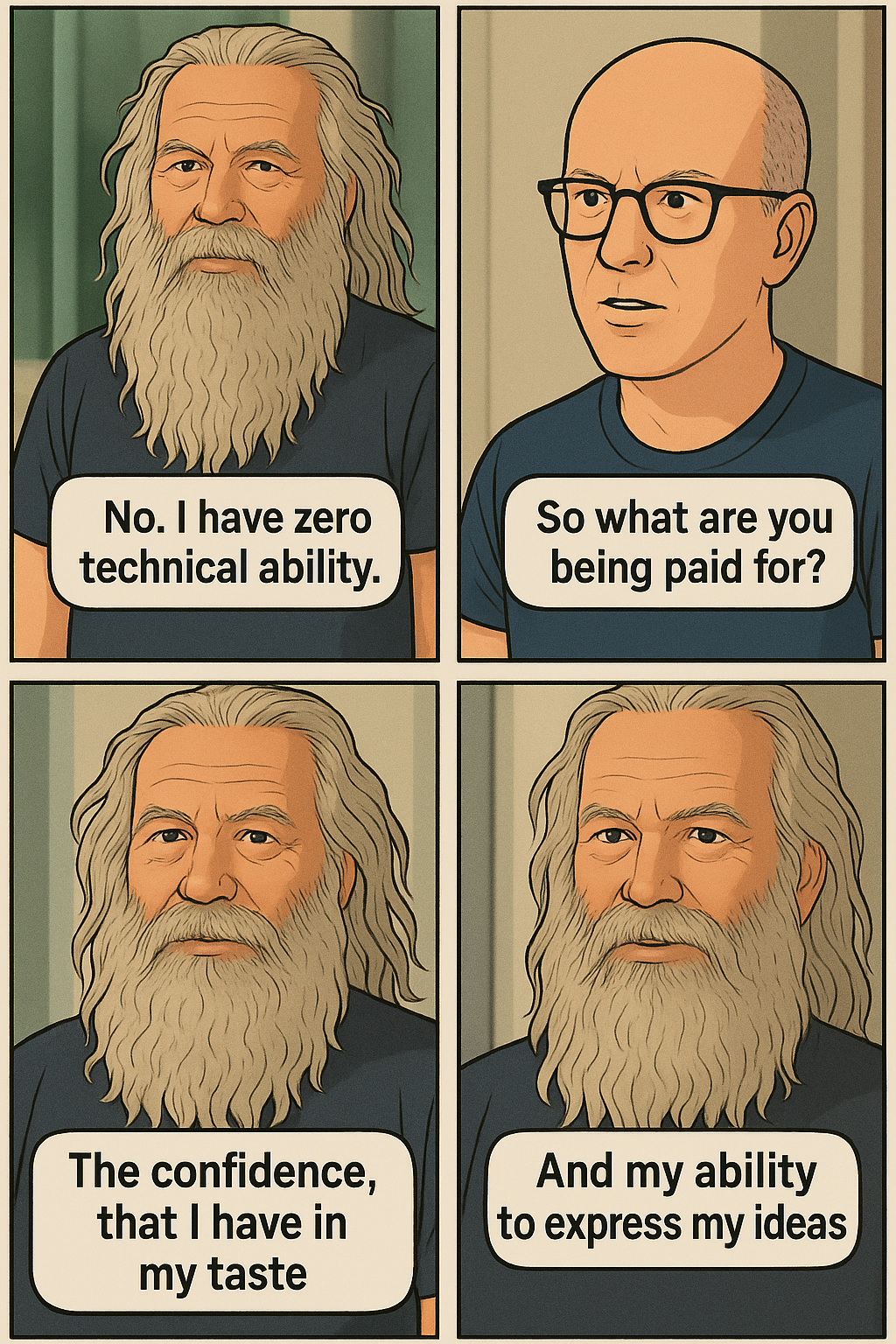
I love this quote. Not just because I respect Rubin as an artist and creative thought-leader, but because what he’s describing is exactly what it feels like to work with AI-generated music. The producer’s job is not to play every instrument or engineer every sound. It’s to identify what’s working, what isn’t, and to shape the result into something emotionally and artistically true.
In my own practice, that means writing lyrics from scratch, generating anywhere from 2 to 200 versions of a track, and evaluating each one with care. I’m not choosing based on novelty or output speed—I’m listening for the moment when a version aligns with the feeling I had in my head. If it doesn’t, I generate more. If I stumble onto something better than what I imagined, I pivot. In either case, it’s my taste doing the work.
That’s why I often say, somewhat tongue-in-cheek and somewhat seriously: I only release “bangers.” If my job is to curate and refine, then I won’t settle for something that’s just okay. I’ll keep pushing until it’s excellent.
This process isn’t passive—it’s iterative, emotional, and deliberate. And in many ways, it’s a new art form.
Polite Riot
One of my most personal projects is a rap persona called Polite Riot. The voice is synthetic. The beats are AI-generated. And I don’t rap on the tracks myself. But it’s some of the most autobiographical work I’ve ever made. Polite Riot’s opening salvo “Popcorn” declares proudly in the bridge “My voice is synthetic but these emotions are real, just a new way to express how I feel.”
Something unlocked when I stepped out from behind my own voice. Like artists who wear masks on stage—Slipknot, DeadMau5, MF DOOM—I found that distance allowed a kind of emotional transparency I’d never accessed before. The lyrics are deeply personal. The structure is crafted with care. And because I can now generate production that matches the tone and energy I’m writing toward, the result isn't just music, it's almost something new.
Before AI, I might have written these same thoughts in a long personal essay. You can find a few on this website. Now, they live as music. People close to me have had powerful reactions. My wife cried the first time she heard Intensive Outpatient Therapy. My mom and I sat together, reading lyrics while the music played. My dad—who doesn’t listen to hip hop—started noticing the wordplay. The emotion reached them all in a way text never did.
Introspective and emotionally honest lyricists have been turning personal journals into “diary rap” for generations. What I’m doing isn’t entirely new—but it feels like a shift. Instead of writing and refining lyrics for weeks, saving up for studio time, hunting down collaborators, or learning how to produce beats from scratch, I can now create a studio-quality track as quickly as I can write it. That speed doesn’t diminish the emotion—it unlocks it.
I’ve used this new superpower to explore deep, personal experiences. But I’ve also used it to document fleeting thoughts and everyday moments: a joke, a memory, a weird mood that might’ve otherwise been lost. It’s made me realize that music doesn’t always have to be monumental to be meaningful. Sometimes it can just be an idea captured in the form of a song, rather than a blog post.
There’s a part of me that wants to call it “Blog Rap”—because that’s how it functions: fast, raw, expressive, digital, and deeply personal. But that label doesn’t quite sit right, and maybe that’s because this really is something new. Not quite diary rap. Not quite blogging. Something in between. A new lane where songwriting meets storytelling, and musical identity becomes an extension of narrative voice. And all of it is possible because of the ease and speed of its creation.
This is what excites me most about AI tools in music: they don’t replace the human voice.
They make it louder. They make it clearer. They make it possible.
So What Makes a Producer?
At its core, producing has always been about listening. Knowing what a song needs. Knowing when something is done. Or when it needs one more pass. You don’t have to press the keys or play the drums. You have to make the decisions that shape the outcome.
Today, that decision-making looks a little different. Instead of tweaking knobs or sitting behind a mixing desk, I generate variations. I try out different voicings, styles, tempos, and instrumental pairings. Sometimes I even reprocess vocals through different character voices using ElevenLabs. I arrange everything myself. I write every lyric (even if it was assisted by a ChatBot). And I throw out the versions that don’t hit the emotional mark.
None of this is automatic. None of it is random. And none of it is “just pushing a button.” It’s a hybrid process that blends authorship with curation, intention with experimentation.
When people ask me what it’s like to make music this way, I don’t say it’s easier. I say it’s more direct. The tools remove barriers—but they don’t remove judgment. If anything, they make your taste more important than ever.
The producer’s job hasn’t disappeared. It’s simply evolved. And for those of us who are willing to adapt, it’s opening new creative lanes that were unthinkable even five years ago. I’m not here to convince anyone to abandon traditional methods. But I do think we need to expand the conversation around what producing music can look like—and who gets to do it.
Because at the end of the day, the machine doesn’t decide what gets released.
The artist does.
And that’s still the most important role in the room.